
How Safe Futures Works: Technical Documentation
Safe Futures is a service that protects crypto positions with options. You choose the protection parameters (the asset, the activation price, the insurance term and the insured amount), our algorithm selects the necessary options, you pay the premium in a stablecoin, the platform verifies the payment on the blockchain, immediately buys the options on the exchange and places an order to sell them in advance. If the asset price reaches the activation price you chose, the order is filled, the insured event occurs, and the payout is sent to the wallet you paid from.
Workflow
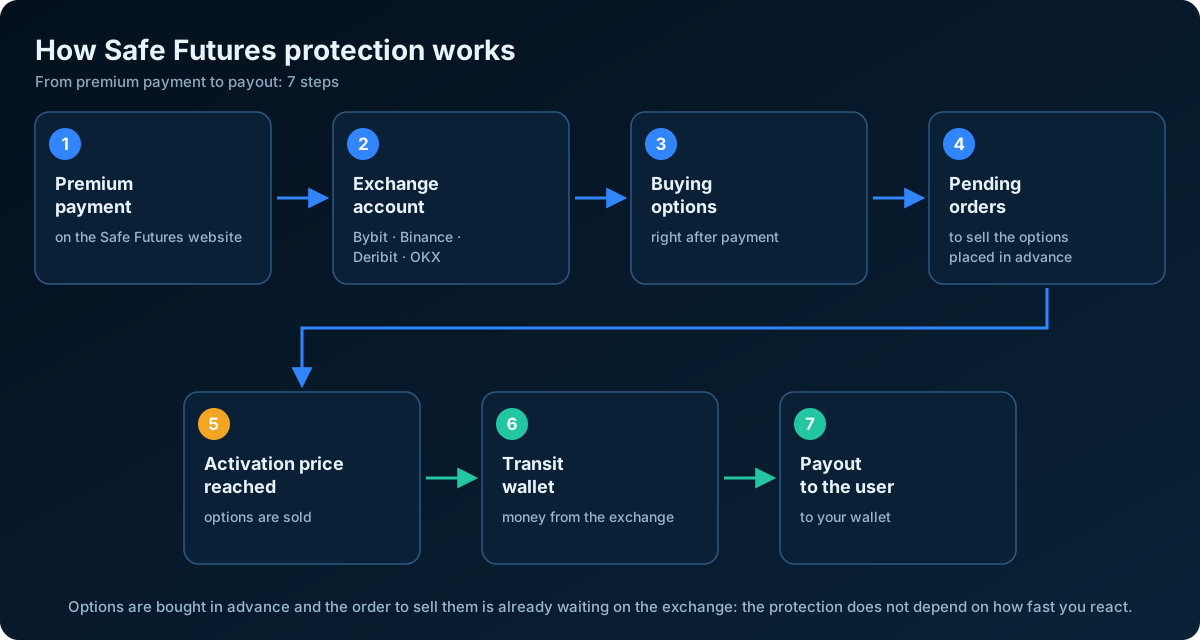
- You pay the premium on the website.
- The money arrives at the platform's exchange account.
- The necessary options are bought immediately.
- Pending orders to sell them are placed.
- If the asset price reaches the activation price, the options are sold.
- The money goes from the exchange to the transit wallet.
- The payout goes from the transit wallet to the user.
What you choose
- Asset: BTC or ETH.
- Protected amount in dollars: the sum you want to receive when the insured event occurs.
- Activation price: the asset price level at which the protection is triggered.
- Protection term: a date from the list of option contracts that actually exist on the exchange.
- Payment network and token:
| Network | Payment token |
|---|---|
| Ethereum | USDT |
| BNB Smart Chain | USDT |
| Base | USDC |
| Arbitrum One | USDT |
The calculator shows the premium cost before payment. Support for Solana and Tron is planned.
Step by step
1. Payment. You transfer the premium amount from your wallet (for example, MetaMask) to the platform's address in the selected network. The platform never asks for your private keys and does not get access to your wallet.
2. Payment verification by transaction hash. After the transfer, the website sends the transaction hash to the platform. The platform determines the network on its own, makes sure the transaction was successful and the token and recipient are correct, and that the amount covers the policy price you saw in the calculator. The address of the wallet the payment came from is taken from the transaction itself: the payout will go to it. The hash becomes your policy number and can be used only once.
3. Limits on policy issuance. A policy is issued if no more than 60 seconds have passed since the price was shown and the asset price has changed by no more than 0.5%. The platform measures time and price using its own quote record, not browser data. If the policy cannot be issued (meaning the price has changed significantly), you simply need to repeat the operation.
4. Buying options. If the activation price is below the current price, the algorithm selects a put option (protection against a fall), if above, a call. The platform chooses the nearest expiration date not earlier than the one you selected, the strike is chosen optimally relative to the activation price, and the number of options is such that the payout covers the protected amount. The purchase is made at the exchange's fresh price.
5. Pending sell order. The sell order is placed only after the exchange has confirmed that the purchase was filled. Its number is saved in your policy, so the insured event is determined by the filling of this very order. It waits on the exchange; you do not need to watch the market.
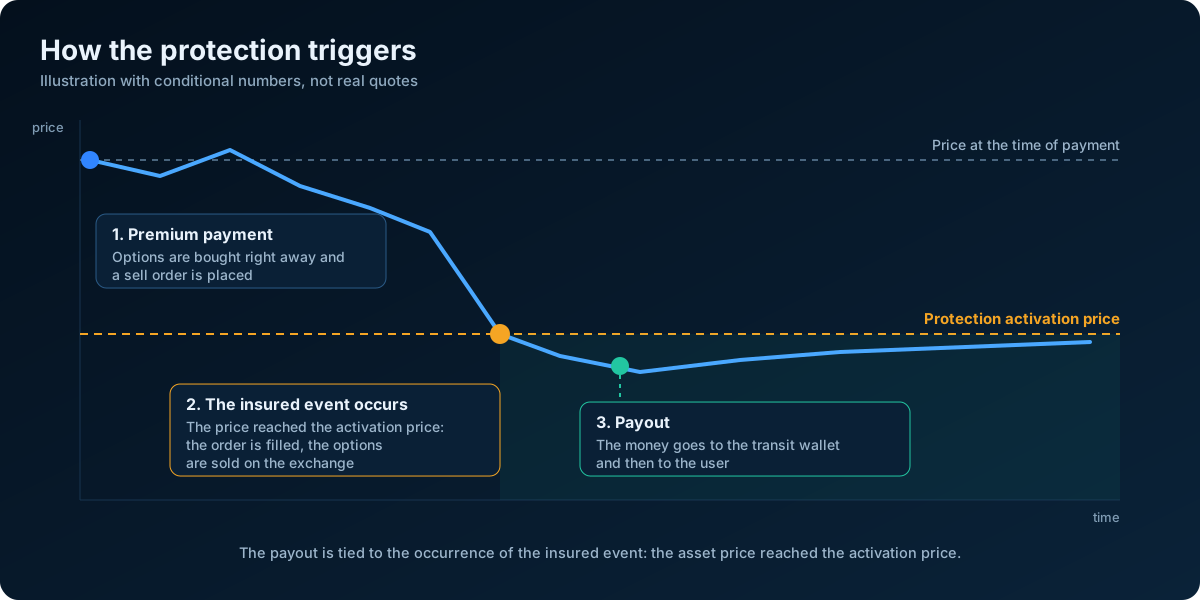
6. Insured event. When the asset price reaches the activation price, the options rise in price to the calculated level, the order is filled, and the options are sold. The payout is tied to the occurrence of the insured event.
7. Transit wallet and payout. The proceeds from selling the options go from the exchange to the platform's transit wallet. The platform then sends the payout to the payer's wallet in the same network you paid in. The payout amount equals the protected amount you set at issuance.
Why options and pending orders
A stop-loss is executed at the market price, and in a sharp crash the execution price may turn out noticeably worse than the one set. The option is bought in advance and the order to sell it is already on the exchange, so the protection does not depend on whether you manage to react, and during sharp price moves volatility increases and options become noticeably more expensive, which favorably distinguishes them from stop-losses, where, on the contrary, the probability of slippage and worse execution increases.
Example (illustrative numbers)
BTC costs 100,000 USD, and you want to protect 10,000 USD against a fall to 90,000. You pay the premium. The platform buys put options for a suitable date and places an order to sell them. If the price reaches 90,000, the order is filled, and a payout of 10,000 USD goes to the wallet you paid from.
Security and transparency
- The platform does not request private keys: you pay from your own wallet.
- The payment is confirmed by the transaction itself on the blockchain; one hash, one policy.
- The payout goes to the payer's address taken from the transaction, not to an address entered manually.
- Access to your policy history is granted by signing a message with your wallet. This signature is read-only and does not allow anyone to dispose of your funds.
- Prices are taken from the exchange; the time and price limits are checked by the platform using its own data.
Limitations and risks
- The protection works only if the sell order is filled. During sharp moves or low liquidity, the execution price may differ from the calculated one.
- If the insured event did not occur during the protection term, the options expire and the premium is not refunded.
- Not all dates and strikes are available, only those that exist on the exchange.
- If a policy cannot be issued (for example, the price managed to change), the payment will not go through and you need to repeat the operation. This means that during the payment the asset price, and accordingly the price of the options, changed by more than the set amount, or you did not manage to make the payment within 60 seconds. The timer is set deliberately to ensure the minimum possible time between payment and buying the options, because during heightened volatility prices can change significantly over a short period.
- This material is for information purposes only and is not investment advice.
Frequently asked questions
What is the activation price? The asset price level at which the insured event occurs.
Do I need to understand options? No, the platform selects and buys them.
Where will the payout go? To the wallet you paid from, in the same network.
What is the policy number? The hash of your payment transaction.
Which networks and tokens are supported? Ethereum, BNB Smart Chain and Arbitrum One with USDT, Base with USDC.
Summary
Safe Futures turns options hedging into a clear chain: you pay the premium, the platform verifies the payment by hash, buys the options and places an order to sell them, and when the activation price is reached the payout goes to the payer's wallet.